Use case
The Economics of Better Decisions
Digital teams make expensive decisions about ecommerce platforms, customer experience, SEO, content, AI and transformation.
Before deciding what to invest in, CompComp helps establish where the competitive gaps actually are and how strong the evidence behind them is.
The cost is not only the analysis
Competitive research commonly involves manual research, spreadsheets, analytics tools, agencies, workshops and individual expertise. That effort is visible. The cost of acting on the wrong conclusion is usually not.
Visible cost
Time spent:
- researching competitors
- collecting evidence
- documenting findings
- comparing participants
- preparing presentations
- repeating the process later
Hidden cost
The potentially larger cost of:
- solving the wrong problem
- funding the wrong initiative
- assuming a technology problem when the gap is elsewhere
- investing in areas where the organisation is already competitive
- prioritising opinions over evidence
Solving the wrong problem can be significantly more expensive than analysing it properly.
A decision-making principle, not a measured CompComp result.
Four areas of economic value
1. Reduce research effort
A structured comparison can reduce the repetitive collection and organisation of competitive evidence. It does not make all research time disappear; expertise and interpretation still matter.
Hours avoided × internal cost per hour = potential research value
Illustrative example – not a CompComp customer result
- Companies compared
- 5
- Research per company
- 6 h
- Consolidation
- 5 h
- Total per assessment
- 35 h
- Hourly cost
- €100
- Cost per assessment
- €3,500
- Quarterly, per year
- €14,000
2. Reduce the cost of wrong priorities
An organisation is considering a €250,000 digital initiative because competitors appear to offer a better experience. Competitive evidence may show that the main gaps are not necessarily technology related. They could instead concern:
- Positioning
- Audience clarity
- Search readiness
- AI visibility
- GEO readiness
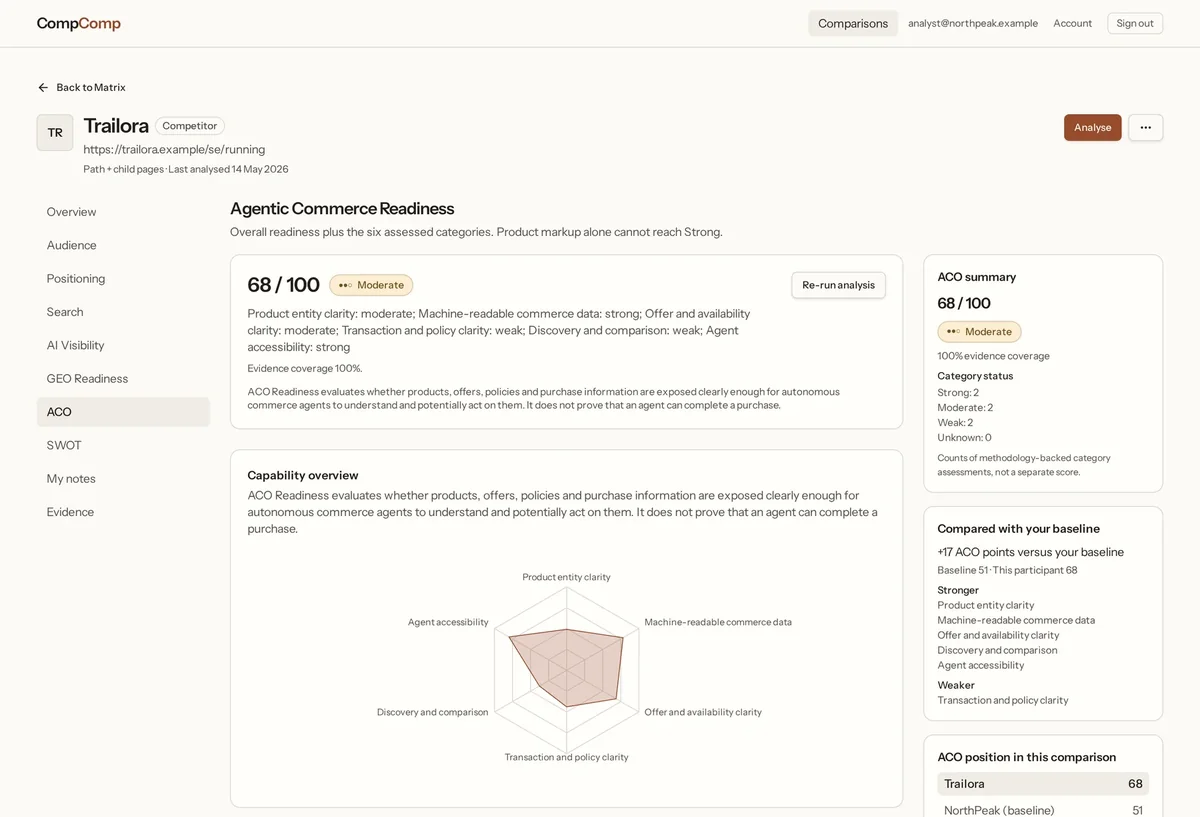
- ACO readiness
- Content and evidence quality
CompComp does not decide whether the initiative is right. It provides additional evidence before the investment decision is made.
Instead of only asking
How much does competitive analysis cost?
Ask
What is the value of validating a €250,000 decision before making it?
Illustrative example – not a CompComp customer result
3. Prioritise where evidence shows a gap
Being different from a competitor does not automatically mean being worse.
- Competitive gaps
- Evidence suggests attention may be justified.
- Competitive strengths
- Areas where the organisation already performs well.
- Comparable performance
- Differences may not justify additional investment.
- Unknowns
- Available evidence is insufficient to support a conclusion. Unknown is not a weakness or a gap.
Move the conversation from “What could we improve?” to “Where does the evidence justify further investigation or investment?”
4. Make investment decisions easier to defend
Ecommerce, marketing, IT, product, sales, agencies and management can interpret the same competitive situation differently. CompComp provides a common evidence structure.
- 1What did we observe?
- 2What does the evidence support?
- 3How strong is the evidence?
- 4How do we compare?
- 5Where should we investigate or invest next?
CompComp does not make the investment decision. It helps make the evidence behind that decision more explicit.
Calculate the economics of your competitive research
Estimate the cost of your current competitive research process and put it in context with the investment decision it supports.
Your current research effort
- Research hours per assessment
- 35 h
- Research cost per assessment
- €3,500
- Annual research hours
- 140 h
- Annual research effort
- €14,000
Decision exposure
€250,000
This is the investment being evaluated with the help of competitive evidence.
The larger the decision, the more important it becomes to understand the evidence behind it.
What would better competitive analysis need to change to pay for itself?
The economic case does not require CompComp to replace your existing research process. Even reducing repetitive research effort or helping challenge one unsupported assumption can change the economics of a decision.
CompComp is free during beta, so no break-even figure is shown yet.
A €500,000 decision deserves more than an assumption
Investment decision
- €500,000
Competitive evidence
- Audience
- Positioning
- Search
- AI Visibility
- GEO
- ACO
- SWOT
Possible next actions
- Invest
- Investigate
- Prioritise
- Defer
These are possible next actions for your team, not recommendations generated by CompComp. CompComp provides evidence to support the decision; it does not make it.
Illustrative example – not a CompComp customer result
Questions about the economics of better decisions
No. CompComp does not claim to directly generate revenue, guarantee savings or produce a specific return on investment. The economic value comes from reducing repetitive research effort, challenging unsupported assumptions and making expensive decisions easier to explain and defend.
More than the visible hours. Beyond collecting evidence and documenting findings there is the hidden cost of solving the wrong problem: funding an initiative where the real gap is elsewhere, or investing in areas where you are already competitive. The calculator on this page lets you estimate the visible part with your own numbers.
It separates real gaps from assumptions. When a €250,000 or €500,000 initiative is on the table, knowing whether the gap is in technology, positioning, search readiness, AI visibility or content quality changes where the money should go, and whether it should go anywhere at all.
No. Every figure on this page is an illustrative example, clearly labelled as such. They are there to show how the economics of a decision can be reasoned about, not to report outcomes from CompComp customers.
CompComp is free during beta, so no break-even figure is shown on this page yet. When pricing exists, the break-even calculation will be added. The current plans are described on the pricing page.
No. CompComp provides structured, evidence-backed competitive context: where gaps are, how strong the evidence behind them is, and what remains unknown. The decision, and the responsibility for it, stays with your team.
Find the why before deciding what to replace.
The larger the proposed investment, the more valuable good evidence becomes.
If you are considering a major ecommerce, digital experience, SEO, AI or transformation investment, competitive assessment should not simply tell you that competitors are different. It should help you understand why.
Compare your position. Examine the evidence. Then decide where the next euro should go.